

Palani Dhandayuthapani Temple, Dindigul
· 315, North Giri Street, Palani, Dindigul District, Tamil Nadu - 624601
01 · Image
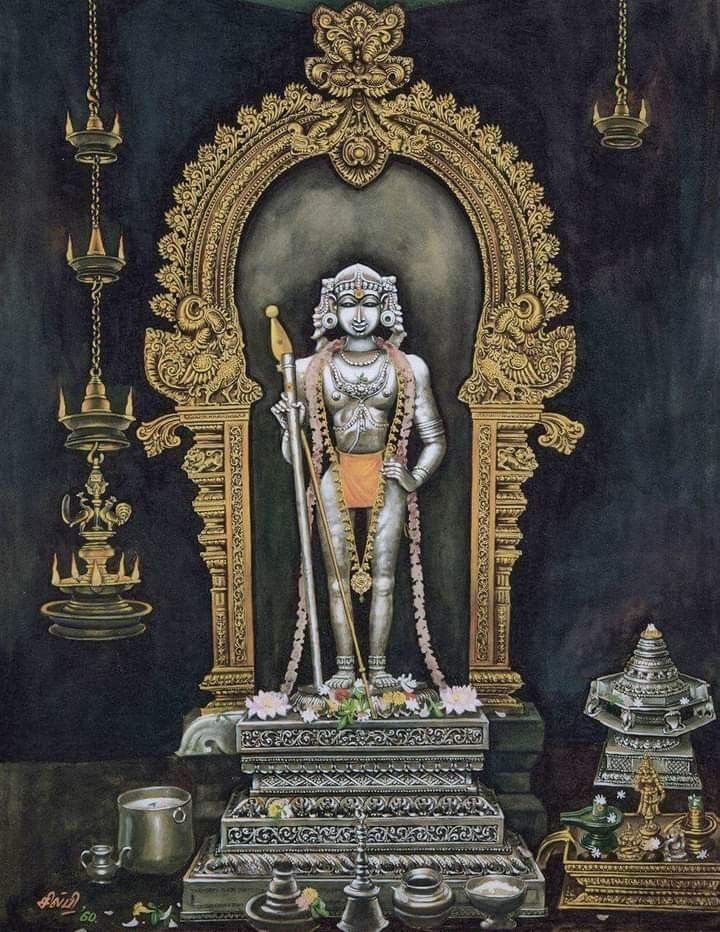 Plate shown — 3 680 × 1 760
01 / 05
Gallery ·Scroll
02Summary
The Arulmigu Dhandayuthapani Swamy Temple in Palani is the third of the six sacred abodes (Arupadaiveedu) of Lord Murugan. Situated atop Sivagiri Hill, the temple is famed for its unique Navapashanam idol created by Siddhar Bhogar and its vibrant pilgrimage traditions..
The Arulmigu Dhandayuthapani Swamy Temple, located in the town of Palani in Dindigul district, Tamil Nadu, is one of the most prominent and visited Hindu pilgrimage centers in South India. It is revered as the third of the Arupadaiveedu, the six sacred abodes dedicated to Lord Murugan (Kartikeya). Perched atop the Sivagiri hill at an elevation of approximately 1,500 feet above sea level, the temple overlooks the surrounding plains and the foothills of the Palani Hills range, an extension of the Western Ghats.
The temple complex draws millions of devotees throughout the year. Pilgrims traditionally perform Giri Vulam, circumambulating the base of the Sivagiri hill along Giri Veethi (Giri Street) before ascending to the summit. Access to the hilltop shrine is available via a flight of 659 stone steps, an inclined ropeway, and funicular railway winch systems. The temple is managed by the Hindu Religious and Charitable Endowments (HR&CE) Department of the Government of Tamil Nadu.
The presiding deity of the temple is Lord Dhandayuthapani, a form of Lord Murugan depicted as an ascetic who has renounced worldly riches. The deity stands in a serene posture, clad in a simple loincloth (kavanam), holding a wooden staff (dhandam) in his right hand and keeping his left hand resting on his hip. This iconography represents spiritual wisdom, austerity, and detachment.
According to tradition, the main idol enshrined in the sanctum was consecrated by the legendary Siddhar Bhogar, one of the eighteen great Tamil Siddhars. The idol is uniquely crafted from Navapashanam, an amalgam of nine poisonous mineral substances combined in precise proportions to form a durable, highly medicinal alloy. The holy offerings (abhishekam) bathed over this idol—such as milk, sandalwood paste, and Panchamirtham (a traditional mixture of five ingredients including plantain, jaggery, ghee, honey, and cardamom)—are believed by devotees to absorb curative properties.
Within the temple precincts lies the subterranean shrine of Siddhar Bhogar, where he is believed to have entered Nirvikalpa Samadhi. Major festivals celebrated at the temple include Thaipusam, Panguni Uthiram, Vaikasi Visakam, and Kanda Sashti. Devotees routinely carry Kavadi (adorned wooden arches) and offer shaved hair (tonsure) as acts of devotion and fulfillment of vows.
The origin of the Palani temple rests upon both sacred devotional literature and documented historical records, which together outline its evolution across centuries.
Sthala Purana (Devotional Legends): According to traditional narrative, Sage Narada once brought a divine fruit of wisdom (Jnana Palam) to Mount Kailash to present to Lord Shiva and Goddess Parvati. To determine which of their sons deserved the fruit, a contest was held to see who could circle the universe first. Lord Murugan set off on his peacock to circumambulate the cosmos, while Lord Ganesha circled his parents, invoking them as the universe itself, and won the fruit. Aggrieved by this outcome, Murugan renounced his divine attire and withdrew to the hill of Sivagiri in South India. Shiva and Parvati consoled him, declaring that he himself was the fruit of ultimate knowledge—Pazham-nee ("You are the fruit"), giving the hill town its name, Palani.
Another integral tradition involves Idumban, a disciple of Sage Agastya, who was instructed to carry two hills—Sivagiri and Saktigiri—slung on a wooden pole (the precursor to the Kavadi). When Idumban rested at Palani, Murugan prevented him from picking the hills up again, ultimately granting Idumban the role of guardian deity at the foot of the hill.
Historical Context: Historical evidence shows that the temple enjoyed patronage from ancient South Indian dynasties. Epigraphical records indicate structural contributions and land grants made by Chera kings (such as Cheraman Perumal), Medieval Cholas, Pandyas, and later rulers of the Vijayanagara Empire and Madurai Nayakas. Inscriptions carved on the stone walls of the lower and upper corridors record endowments for rituals, maintenance of lamps, and construction of pillared mandapams by regional chieftains (Palaiyakkarars).
The Palani Dhandayuthapani Temple is built in the traditional Dravidian architectural style, adapted for a high hilltop setting. The central sanctum (sanctum sanctorum) is crowned by a striking golden Vimanam (tower), plated with gold leaves. The outer walls of the garbha griha and the inner prakaram (circumambulatory path) feature granite pillars carved with motifs of deities, celestial dancers, and historical patrons.
Key architectural highlights include:
- Golden Vimanam: The superstructure over the main sanctum, fully gilded and visible from surrounding vantage points.
- Navapashanam Shrine: The inner sanctum engineered to preserve the ancient medicinal idol created by Siddhar Bhogar.
- Bhogar Cave Shrine: Located in the southwestern corridor of the main temple court, an underground chamber dedicated to Siddhar Bhogar, containing an icon of Goddess Bhuvaneshwari.
- Pillared Mandapams: The Karthigai Mandapam and outer corridors featuring intricately sculpted stone pillars and ceilings adorned with traditional murals.
- Sub-shrines: Shrines dedicated to Goddess Valli, Goddess Deivanai, Lord Vinayaka, and Lord Shanmugar.
- Sacred Water Bodies: The Saravana Poigai tank and the Shanmuga Nadi river located at the foot of the hill, where pilgrims take ritual baths before ascending.
04 · Divinity
Temple Deities
- 01Dhandayuthapani SwamyMain Moolavar idol made of Navapashanam (nine medicinal minerals) by Siddhar Bhogar, depicting Lord Murugan in an ascetic form with a staff.Presiding Deity
- 02ChinnakkumaraswamyProcessional deity worshipped during rituals, daily processions, and major festivals.Utsavar
- 03Pada VinayagarSituated at the foot of the hill; worship traditionally starts here before ascending.Parivara Deity
- 04KailasanatharShrine dedicated to Lord Shiva located within the inner prakaram of the hill temple.Parivara Deity
- 05Periyanayaki AmmanShrine located within the temple complex precinct.Parivara Deity

05 · Additional Info
Heritagies, Information.
01 PeriodSangam period origins (c. 4th-5th century CE), major structural expansions 9th-16th century CE.
02 DynastyChera, Pandya, Vijayanagara, Nayak.
03 StatusArupadai Veedu (3rd Abode of Lord Murugan).
04 Sthala VrikshamNelli (Amla / Indian Gooseberry).
05 TheerthamShanmuga Nadi, Saravana Poigai, Idumban Kulam.
06 AgamamKumara Tantram.
Inscriptions
Inscriptions on temple walls document royal patrons including King Cheraman Perumal, Pandyan rulers, and Nayak chieftains recording endowments, land grants, and temple renovations..
Cultural Significance
One of the six sacred abodes (Arupadai Veedu) of Lord Murugan. Known for the GI-tagged Palani Panchamirtham and the tradition of carrying Kavadi..
Legends
Sage Narada brought the Fruit of Wisdom (Gnanapazham) to Kailash, triggering a contest between Ganesha and Murugan. Angered by the outcome, Murugan renounced material wealth and retreated to Palani Hill as Dhandayuthapani. The main deity idol was created and consecrated by Siddhar Bogar using Navapashanam (nine poisonous minerals combined into a potent healing compound)..
Transport Details
-
Railway Station
Palani Railway Station
Located approximately 2.5 km from North Giri Street. Regular trains connect to Chennai, Madurai, Coimbatore, Pollachi, and Palakkad. Auto-rickshaws and local mini-buses are readily available at the station exit to reach the temple base..
Distance2.50 km
-
Bus Stand
Palani Central Bus Stand
Situated about 2 km from the temple foot. Well connected by TNSTC and private buses to major cities like Coimbatore, Madurai, Dindigul, Trichy, and Salem. Town buses and auto-rickshaws frequently shuttle between the bus stand and Giri Veedhi..
Distance2.00 km
-
Airport
Coimbatore International Airport (CJB)
The nearest major operational airport operating domestic and international flights. Travelers can book a direct taxi or take a state transport bus from Coimbatore to Palani (approx. 2.5 to 3 hours travel time)..
Distance102.00 km
07 · Celebration
Festivals
Thaipusam
The grandest annual festival at Palani. Hundreds of thousands of pilgrims walk on foot (Paada Yatra) carrying Kavadis to offer milk and holy items to Lord Dhandayuthapani. Features the grand Car Festival (Therottam) on the main day.
10 DaysPanguni Uthiram
Celebrates the celestial wedding of Lord Murugan and Valli. Devotees walk from Kodumudi carrying holy water from the Kaveri River (Theertha Kavadi) for the deity's abhishekam.
10 DaysKanda Sashti
Commemorates the victory of Lord Murugan over demon Surapadman. Features the dramatic enactment of Soorasamharam at the foothill on the 6th day, followed by Thirukalyanam (divine marriage) on the 7th day.
7 DaysVaikasi Visakam
Celebrates the birth star (incarnation day) of Lord Murugan. Special abhishekams, floral decorations, and chariot processions are held throughout the festival.
10 DaysKarthigai Deepam
A major festival where a huge beacon lamp (Deepam) is lit atop the sacred hill and special oil lamps illuminate the entire hill temple complex.
3 Days
