


Sri Ranganathaswamy Temple, Srirangam
· Srirangam, Tiruchirappalli, Tamil Nadu 620006, India
01 · Image
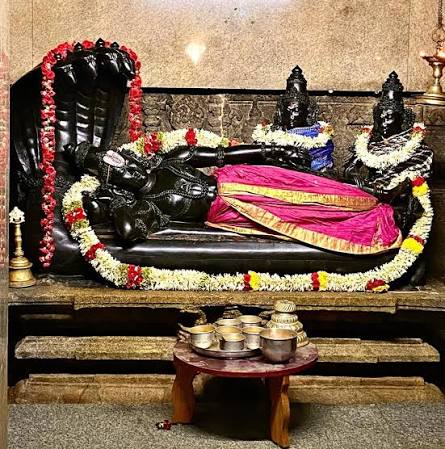 Plate shown — 3 680 × 1 760
01 / 05
Gallery ·Scroll
02Summary
Sri Ranganathaswamy Temple in Srirangam is the premier among the 108 Divya Desams of Sri Vaishnavism. Spanning 156 acres enclosed by seven concentric prakarams and 21 gopurams, it is one of the world's largest functioning temple complexes, celebrated for its ancient history, Dravidian architecture, and deep spiritual heritage..
Sri Ranganathaswamy Temple, located on the riverine island of Srirangam in Tiruchirappalli district, Tamil Nadu, is one of the largest operating Hindu temple complexes in the world. Formed by the branching of the Kaveri and Kollidam rivers, the temple precinct spans an area of approximately 156 acres (63 hectares).
The temple occupies the foremost position among the 108 Divya Desams—the sacred Vishnu abodes praised in the Tamil devotional canon of the Azhwars (the Naalayira Divya Prabandham). Within the Sri Vaishnava tradition, Srirangam is reverently known simply as Koyil (The Temple).
The complex is uniquely organized as a self-contained temple town. It features seven concentric enclosure walls (prakarams) that measure over six kilometers in perimeter, housing both sacred sanctums and traditional residential areas within its outer tiers.
The presiding deity of the temple is Lord Ranganatha, a reclining form (Sayana Murti) of Lord Vishnu resting on the coils of the five-hooded serpent Adishesha. The deity resides in the innermost sanctum under the gold-plated Sriranga Vimanam, which is crafted in the shape of an oval Pranavakara (Om-shaped) dome. Uniquely, Lord Ranganatha faces south towards Sri Lanka, an orientation central to temple tradition.
The chief consort, Goddess Ranganayaki (Lakshmi), resides in an independent shrine within the fourth enclosure. Following long-standing ritual traditions of the temple, Goddess Ranganayaki never leaves her shrine enclosure; instead, Lord Ranganatha visits her sanctum during specialized festive occasions.
The temple is also closely linked to Saint Ramanuja, the 11th-century Sri Vaishnava theologian who reformed and standardized the administration, rituals, and worship practices at Srirangam. A dedicated shrine within the temple complex houses his preserved mortal body (Thiru Meni).
According to the temple's traditional legend (Sthala Purana), the consecrated image of Lord Ranganatha emerged from the cosmic ocean and was originally worshipped by Brahma and rulers of the Ikshvaku dynasty, including Lord Rama. After his victory in Lanka, Rama presented the shrine to Vibhishana. En route to Lanka, Vibhishana placed the idol down on the banks of the Kaveri River. The deity chose to remain permanently at Srirangam while granting a boon to Vibhishana that he would perpetually face south toward Lanka to bestow his blessings.
Historically, Srirangam contains an extraordinary epigraphical record of over 800 inscriptions spanning several centuries. The temple enjoyed extensive patronage under major South Indian dynasties, including the Cholas, Pandyas, Hoysalas, Vijayanagara Empire, and the Nayakas of Madurai. Epigraphs document substantial structural expansions undertaken during the reigns of Chola kings such as Parantaka I, Kulottunga I, and Rajaraja III.
In the early 14th century (c. 1311 and 1323 CE), the temple experienced severe disruption during military invasions by forces of the Delhi Sultanate. During this period, the portable deity was safely relocated by devotees to regional sanctuaries, including Tirumala-Tirupati. Worship was formally restored in 1371 CE under Vijayanagara general Gopanna, marking a major period of architectural reconstruction and revival.
Sri Ranganathaswamy Temple is a landmark of Dravidian temple architecture. Its plan consists of seven concentric rectangular enclosures (prakarams) punctuated by 21 magnificent gateway towers (gopurams). The outer three enclosures encompass vibrant residential and commercial streets, while the inner four constitute the primary religious precinct.
The south gateway features the monumental Rajagopuram (Main Gateway Tower), standing 236 feet (72 meters) high with 13 tiers. While its massive granite base dates to the Nayaka period in the 16th century, the superstructure was formally completed in 1987 under the guidance of the 44th Pontiff of Sri Ahobila Mutt, Sri Vedantha Desika Yatheendra Mahadesikan.
Key architectural structures within the complex include:
- Ayiram Kaal Mandapam (Thousand Pillar Hall): A monumental Vijayanagara-era hall containing 953 intricately sculpted granite pillars, used for major assemblies during the annual Vaikunta Ekadasi festival.
- Sesharayar Mandapam: Famous for its monolithic pillar sculptures depicting rearing horses, riders, and mythical creatures carved with extreme detail.
- Garuda Mandapam: A large hall facing the main shrine containing a massive seated statue of Garuda, the divine mount of Lord Vishnu.
- Sacred Tanks: The complex includes sacred water bodies, notably the Chandra Pushkarini and Surya Pushkarini, used for daily rituals and ceremonial baths.
04 · Divinity
Temple Deities
- 01RanganathaswamyReclining posture (Bhujanga Sayanam) facing south on Adishesha.Presiding Deity (Moolavar)
- 02Ranganayaki ThayarHas a dedicated separate shrine within the complex; known as Padi Thandatha Pathini (does not leave her shrine during festivals).Consort (Thayar)
- 03NamperumalThe processional idol of Lord Ranganatha.Utsavar
- 04Azhagiya SingarNarasimha avatar shrine located within the inner precincts.Sub-shrine Deity
- 05ChakrathazhwarSudarshana shrine featuring Yoga Narasimha on the reverse side.Sub-shrine Deity
- 06GarudazhwarMassive seated idol facing the main sanctum sanctorum.Vehicle Deity (Vahana)
- 07DhanvantariShrine dedicated to the god of medicine, unique to this temple complex.Sub-shrine Deity

05 · Additional Info
Heritagies, Information.
01 PeriodSangam era origins; key structural developments 9th–16th century CE.
02 DynastyChola, Pandya, Hoysala, Vijayanagara, Madurai Nayak.
03 StatusDivya Desam.
04 Sthala VrikshamPunnai (Calophyllum inophyllum).
05 TheerthamChandra Pushkarini, Kaveri.
06 AgamamPancharatra Agama.
Inscriptions
Over 800 epigraphical inscriptions dating from the Chola to Vijayanagara periods recording royal grants, endowments, and administrative decrees..
Cultural Significance
World's largest functioning Hindu temple complex; supreme holy shrine (Koil) in Sri Vaishnavism; seat of Acharya Ramanuja..
Legends
Vibhishana consecrated the Ranga Vimanam carried from Ayodhya after Lord Ranganatha refused to move from the banks of the Kaveri, promising to stay facing South towards Lanka..
Transport Details
-
Railway Station
Srirangam Railway Station (SRGM)
Nearest railway station, located within walking distance or a short auto-rickshaw ride from the temple entrance..
Distance1.00 km
-
Railway Station
Tiruchirappalli Junction (TPJ)
Major junction connecting to all primary Indian cities. Taxis, auto-rickshaws, and direct town buses run frequently to Srirangam..
Distance9.50 km
-
Bus Stand
Chatram Bus Stand, Tiruchirappalli
Primary local city bus terminal in Trichy with continuous town bus service to Srirangam..
Distance4.50 km
-
Bus Stand
Tiruchirappalli Central Bus Stand
Main intercity bus terminal connecting Trichy to major cities in South India. Town buses directly to Srirangam depart regularly..
Distance10.00 km
-
Airport
Tiruchirappalli International Airport (TRZ)
Nearest airport servicing domestic and international routes. Taxis and cab services reach Srirangam in approximately 30-40 minutes..
Distance15.00 km
07 · Celebration
Festivals
Vaikunta Ekadasi
The temple's most celebrated grand annual festival divided into Pagal Pathu (10 days) and Ira Pathu (10 days). Features the opening of the sacred Paramapada Vaasal (Heavenly Gate) on the day of Vaikunta Ekadasi.
21 DaysChithirai Thiruvizha
Major annual Brahmotsavam festival featuring the grand Chithirai Ther (Rathotsavam/Car Festival) procession on the 9th day.
11 DaysVasanthotsavam
Spring festival celebrated at the Vasantha Mandapam surrounded by a water trench, featuring unique evening processions of Lord Ranganatha.
9 DaysJestabhishekam
Annual holy bathing ritual (Abhishekam) of the moolavar and utsavar deities, during which golden armors (Kavacham) are weighed, cleaned, and re-adorned.
1 DaysPavitrotsavam
Purification festival where sanctified holy threads (Pavitram) made of silk and cotton are offered to the sanctum and all deities to expiate omissions in daily rituals.
9 DaysOonjal Sevai (Unjal Thiruvizha)
Swing festival conducted at the Oonjal Mandapam where Lord Ranganatha and Goddess Ranganayaki enjoy swing processions amidst divine music.
9 Days
